What you need to know about mobility, falls and an occupational therapist?
Many of the 11 million older adults in the UK struggle with their mobility. NHS statistics report a third of adults over 65, and half of adults over 80, will have at least one fall a year. Some of these falls result in serious injuries, others don’t, but both commonly decrease someone’s confidence.
Almost all falls are preventable if someone has a safe, efficient way of moving about.
Occupational therapists (OT) are the healthcare professionals with expertise to provide practical solutions to problems involving getting up and moving about safely.

How might I know if a relative is having mobility problems?
Generally, people are unwilling to admit limitations. As an OT, I can ask a patient who is in hospital with broken bones following a fall if they have mobility problems. Their response is likely “no, I am fine”. Clearly there is a problem and ideally it would have been beneficial to have recognised it and found a solution before they fell.
Given it is unlikely an older relative will discuss mobility difficulties, you are going to need to observe them and use the clues to work out what is going on.
Things that inform us of mobility difficulties include:
Furniture walking
Instead of crossing open spaces a person will reach and hold onto objects to steady themselves. This may be furniture, door frames and walls. However, when they reach for something that is not fixed it moves, hence they fall.
Going out less, doing less
Someone that used to enjoy days out is now giving non-specific reasons why they are not able to join you. It is likely that they have concerns about being able to walk that far or safely, but disguise these by saying they are not available, suggesting somewhere with less walking, or not wanting to go at all.
Adjusting to minimise the need to move
Someone who says “no thank you” when you offer a drink. It is common for people to cut down their fluid intake if they are worried about being able to move to go to the toilet quickly enough. Alternatively, you may find someone has taken to sleeping in their armchair claiming “it is more comfortable” but the real reason is they are struggling to manage getting to and into or out of their bed.
If I notice a problem, what can the OT do to help?
Noticing is a good thing as it prompts the need for a solution and prevents a fall. As an OT I would come and see the individual in their home with the view to looking at mobility aids, as well as handrails or grab handles.
When an OT is not involved, often someone’s well-meaning relative has asked the internet to show them mobility aids. The choice is overwhelming, and they lack the expertise to know which one to choose. Often something is purchased but is either unsuitable, the user isn’t confident enough to use it, or it is the wrong thing and potentially dangerous. Anything brought but never used consumes money and leaves the original problem unsolved.
It is probably worth saying that employees in mobility aid shops are salespeople. Their job is to sell, not to assess someone’s needs in the way an OT would. Potentially increasing the likelihood of you spending money on an unsuitable product.
Which is the right mobility aid?
Walking sticks
As an OT we have knowledge about the whole range of mobility aids. Starting with a walking stick that offsets a minimal need by providing an additional point of contact with the floor. It informs someone about the ground in front of them and gives them confidence.

Wheeled Walkers
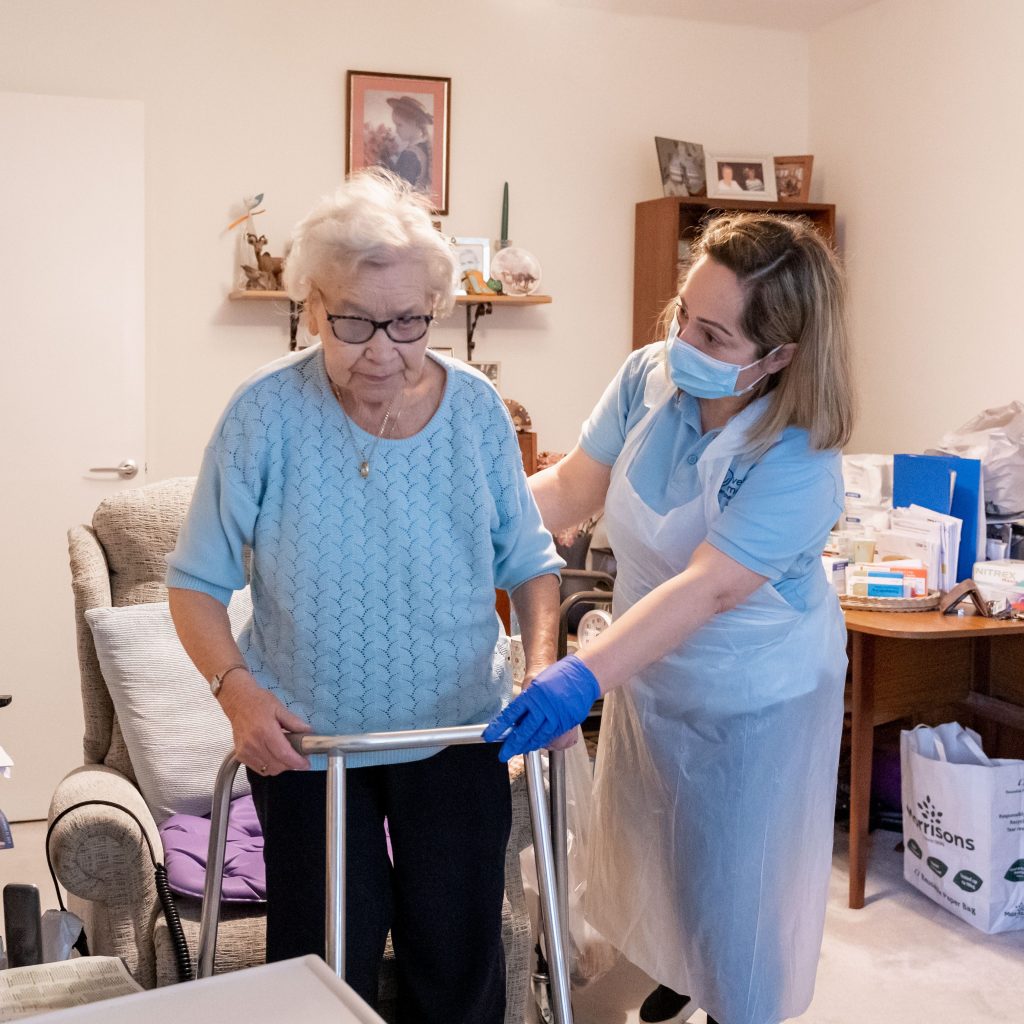
Progressing onto a wheeled walker for someone who needs more support. Wheeled-walkers come with 3 or 4 wheels. The size of the wheels dictates what surface it is suitable for. Some also double as a seat.
They all have a braking system which the user needs to understand and physically be able to operate. For example, someone with arthritis in their hands may struggle with brakes that require dexterity, while someone with cognitive impairment may not understand how to use brakes or may not process quick enough to apply them in a timely manner.
Zimmer Frames
When someone needs something that cannot ‘get away’ from them, we look to move away from an aid fully on wheels. Zimmer frames come with small front wheels, or no wheels at all. This means the frame will only go forward when the user picks it up and moves it. These work well on smooth surfaces but become difficult on carpet. Their big footprint requires the user to take a series of steps, moving the frame as they go, when turning.
Often there is not space to do this in a downstairs toilet. Therefore, the user will abandon the frame outside. In which case the OT would think about what handrails are needed in the bathroom to provide stability instead of the frame.
In many aspects of life we have multiple options, such as several pairs of shoes allowing us to pick the most appropriate ones for what we are about to do. Mobility aids are no different. Your relative may have several aids for different scenarios.
Wheelchairs
Hence, it may be necessary due to energy levels, eyesight, or time available for someone to also use a wheelchair when travelling longer distances. An OT will consider not only the person sitting but also the person pushing. If the person pushing hurts their back because the chair handles are the wrong height, the person in it is too heavy, or they struggle to lift the chair when stowing it, they are no longer able to complete their care duties. Hence, we need to consider everyone involved.
Manual Wheelchairs
Manual chairs come with big wheels for the user to push themselves or small wheels for someone else to push. The size of the wheels dictate what surfaces it will handle. Small wheels are for indoors only. Unless there is a safety reason suggesting otherwise, a chair with large back wheels is preferable for pushing and user comfort. Be aware that “lightweight” often equates to flimsy, hard to push and uncomfortable to sit in. Price is a good indicator of quality. Chairs come in different sizes, need a cushion, and should fit the user.
Electric wheelchairs
Other options include things with batteries to assist such as an electric chair or a mobility scooter. Electric chairs offer mobility with minimum effort but are big and heavy making them difficult to store and transport. Electric chairs need to fit the user snugly.
Mobility Scooters
Scooters come in many sizes. You choose which one based on what it is for, the range required, user factors and storage space.
All users of battery powered aids need good processing skills, spacial awareness and adequate sight. Else, they become a hazard since they are then an uncontrolled heavy item with momentum which is going to cause injury to the user and anyone they hit.
Why work with an OT?
Making the right choices
Given the sheer number of options, let alone different hand grips and other adaptions available for each – there is always merit in having OT input as the chance of ‘guessing’ the correct one(s) is negligible.
It may be possible to obtain a stick or zimmer via the NHS, likely following a long wait. These items are not expensive meaning people may wish to purchase their own since they are required immediately.
Style over substance
Items supplied by the NHS only consider medical need and not aesthetics. The common reasons older adults give for non-compliance with mobility aids is not wanting something that looks clinical. It signals aging and highlights their difficulties. Else, they do not understand how to use the item or why it is needed.
If you purchase your own item, you have choice over colour and style – potentially meaning an aid goes from a negative item signaling disability, to an accessory for their outfit much like matching shoes, tie or a bag would be. Therefore, removing negativity as others may strive to follow their trend. Colour is also important when someone has limited vision.

Training for safety and maintenance
The OT is not there just to suggest a piece of equipment. They should be providing training to the user so they are confident in using the item and should train carers so they can continue to prompt correct use. The OT should explain how to carry out checks and maintenance, so it remains safe and useable. Lastly, you should re-engage with an OT if the user or carer needs change.
Using a mobility aid is a small part of the more complex factors involved in safe efficient mobilisation. Moving between different floors, over thresholds, and navigating obstacles in the community are a whole other extensive topic that may become a consideration after someone has the appropriate aid to mobilise efficiently.
My name is Ann. I am an independent OT. My passion is making sure everyone can experience a good quality of life. The lack of resources available to provide proactive OT input led me to open a not-for-profit organisation called Occupational Therapy Surrey CIC. We combine our lived and professional experiences to offer timely robust OT solutions accessible to all. Find out more about us by visiting www.occupationaltherapysurrey.co.uk We offer services to individuals and organisations within Surrey and its surrounding counties. |