

Dementia and Alzheimer’s disease are often confused, but they are not the same condition. In this article we explain the difference between dementia and Alzheimer’s.
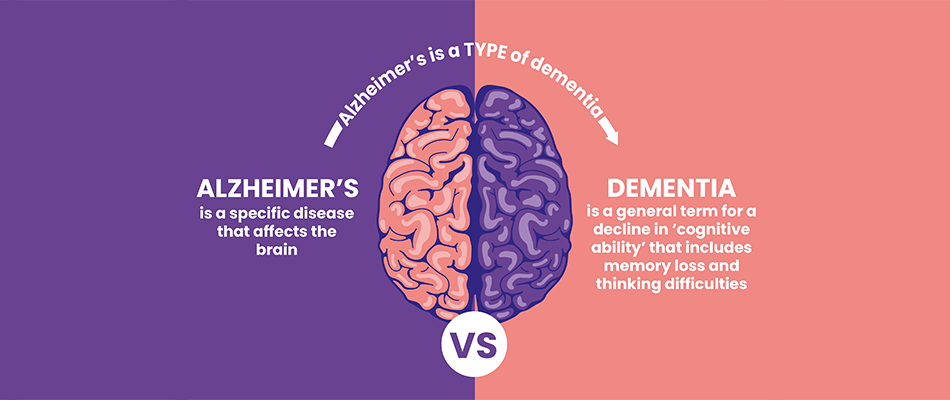
Dementia is a general term describing a group of symptoms that affect memory, thinking, behaviour, and daily functioning.
Alzheimer’s disease is a specific brain disease – and the most common cause of dementia in the UK.
Alzheimer’s is increasingly understood as a detectable biological disease, while dementia is the clinical outcome that may result from it, or from other conditions.
Understanding the difference is essential for accurate diagnosis, treatment, and accessing the right support.
Understanding dementia
Dementia is a syndrome (a collection of related symptoms) caused by damage to brain cells.
This damage disrupts communication between brain cells, leading to cognitive decline. That is to say problems with any aspect of thinking ability.
According to the NHS, common symptoms of dementia include:
- Memory loss
- Difficulty concentrating or making decisions
- Problems with language and communication
- Changes in mood, behaviour, or personality
- Difficulty carrying out everyday activities
Types of Dementia
There are several types of dementia, each with different causes and symptom patterns. The most common include:
- Vascular dementia – linked to reduced blood flow to the brain
- Lewy body dementia – associated with movement problems and hallucinations
- Frontotemporal dementia – affects behaviour and language
- Alzheimer’s disease (the most common cause)
An international team of researchers has identified a brain disorder, known as LATE, that mimics the symptoms of Alzheimer’s disease.
The brain disorder is known as LATE (or to use its very long scientific name, Limbic-predominant age-associated TDP-43 encephalopathy.)
What is LATE?
According to the Alzheimer’s Society LATE is described as a separate disease that can mimic the symptoms of Alzheimer’s disease such as memory problems.
LATE seems to affect individuals over the age of 80 years, progresses slower than Alzheimer’s disease and tends to only affect memory.
Research continues to clarify specific symptoms, identify biomarkers, understand risk factors and develop treatments.
What is Alzheimer’s disease?
Lasting Power of Attorney is a legal document that allows someone else to make decisions on your behalf, if you are no longer able to do so. Many people with dementia choose to make a Lasting Power of Attorney. Find out more from our Guide to Power of Attorney
Key takeaways
- Dementia is a syndrome, not a single disease
- Alzheimer’s disease is the most common cause of dementia
- Multiple conditions can lead to dementia, each with different symptoms and progression
- Early diagnosis through the NHS can help access treatment and support sooner.
Distinguishing between dementia and Alzheimer’s is important for:
- Accurate diagnosis – Different types of dementia require different approaches
- Treatment planning – Some causes, such as vascular dementia, may be partly preventable
- Access to care and support. Tailored services depend on the diagnosis
- Support for carers and families
Frequently Asked Questions about Dementia and Alzheimer's
What's the difference between Alzheimer's and Amnesia?
Alzheimer's disease is a specific degenerative brain disease that causes dementia, which is a syndrome – a collection of related symptoms.
Amnesia is another word for memory loss. There are many things besides dementia that can cause memory loss, such as a recent stroke, insomnia, delirium, or just getting older.
Amnesia can be one of the early signs of dementia - which could be caused by Alzheimer's. If your relative is having difficulty with their memory, it is worth contacting their GP so that they can make an assessment on the cause of their amnesia.
Can you be forgetful and not have Alzheimer's disease?
You can be forgetful and not have Alzheimer's disease. You can be forgetful and not have any type of dementia at all. Forgetfulness can be caused by many things - including just getting older.
What is worse, Alzheimer's or dementia?
It is important to understand that the difference between Alzheimer's and dementia means that one is not worse than the other. Alzheimer's Disease causes dementia. A person with Alzheimer's Disease has both Alzheimer's and dementia.
It is difficult to compare the severity of Alzheimer's to other types of dementia because it is a degenerative condition.
Does everyone with dementia have Alzheimer's disease?
Not everyone with dementia has Alzheimer's disease. Alzheimer's causes approximately 60% to 80% of dementia cases.
Common non-Alzheimer's types of dementia include vascular dementia, Lewy-body dementia, and frontotemporal dementia.
Can you have Alzheimer's and other types of dementia at the same time?
Yes, it is possible to have Alzheimer's and other types of dementia at the same time. This is known as 'mixed dementia'. Read more about mixed dementia in our guide to types of dementia.
This article has been written using information from trusted organisations. Their guidance helps ensure the information here is accurate and reflects current UK law and best practice.
- Alzheimer’s Association Report, 2025 Alzheimer’s disease facts and figures, April 2025.
- NHS, What is dementia, July 2023.
What to do next
Now that you’ve understood the difference between Alzheimer’s and dementia, it could be worth researching the different types of dementia (including Alzheimer’s). Ensuring you’re familiar with the symptoms and treatment can lead to a quicker diagnosis, and in turn, a better quality of life.

- Dementia facts Limited medical research and lack of public awareness has led to many misconceptions about dementia. In our article, we have debunked the myths and identified some important facts about dementia that you should know.
- The NHS website has in-depth information on its dementia hub for people with dementia and their families and friends.
- Use the Alzheimer’s Society directory to find local support services for people living with dementia and their carers.
- Dementia UK has a wealth of information and support to help people live well with dementia.